Two prints made from the same design can disagree in a line no wider than a hair. In one impression it runs cleanly around a wave. In another it stops, leaving a small white break. The difference may mark damage to a printing block. On an engraving, age often announces itself less abruptly: a fine hatch that once gave a cheek or a stone its shade grows faint. The two losses begin on opposite sides of the printing surface.
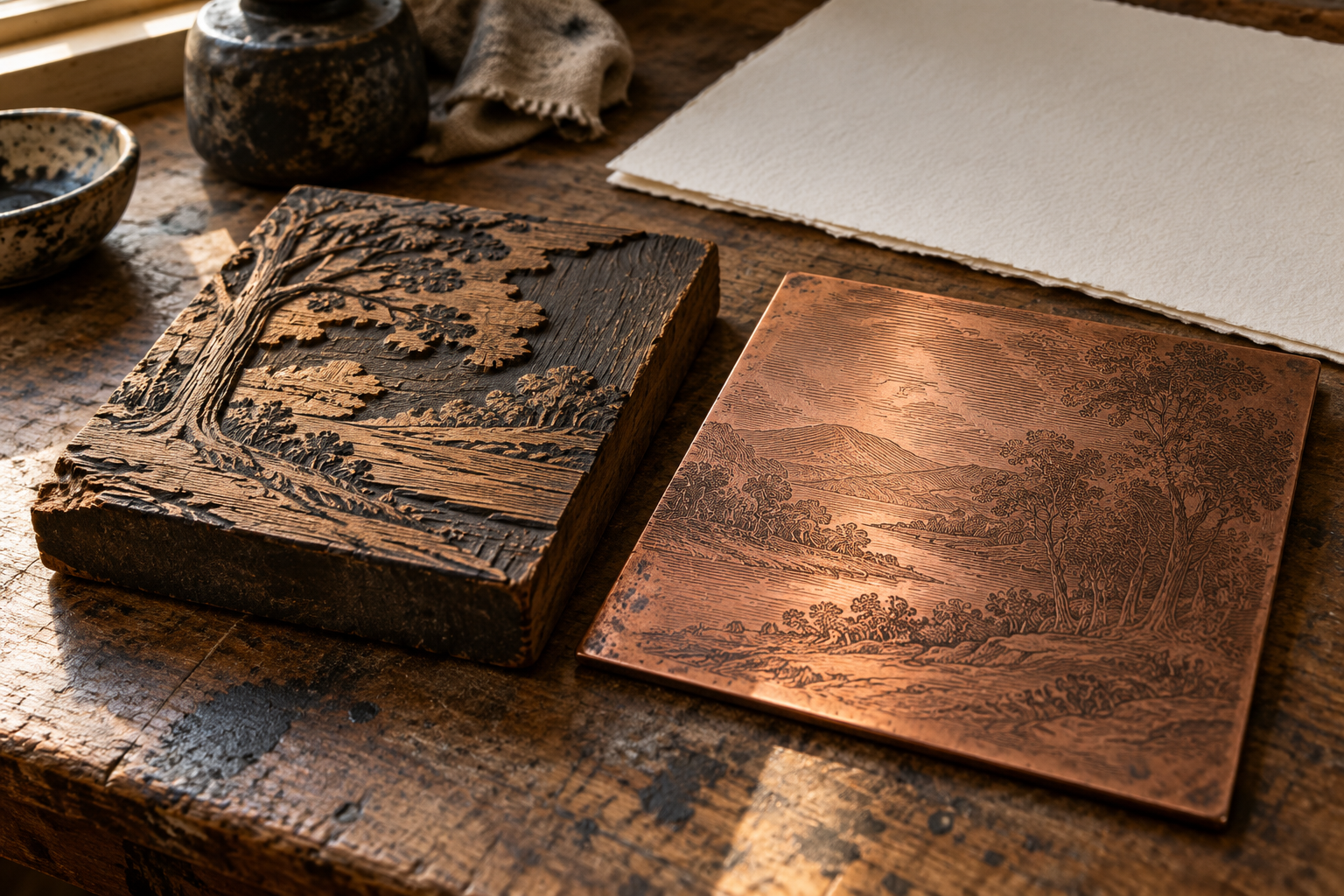
In a woodcut, the cutter removes the wood that should stay white on paper. What remains is a network of raised ridges and broader areas. Ink touches their tops; paper takes the ink when it is pressed against them. The Metropolitan Museum of Art's account of woodcutting shows why a narrow line is vulnerable: it must stand as a thin piece of wood, with empty space beside it. The Met notes that blocks are seasoned to reduce warping and cracking, and that size and thickness affect their resistance to damage. Even before a press runs, the chosen wood and the way it was cut have set limits on what can survive.
An engraving reverses the arrangement. The printmaker drives a burin through metal to make a groove. Ink is rubbed into those recesses, the plate's upper face is wiped, and damp paper is pushed into the grooves under a roller press. The Met's explanation of engraving describes how the depth and width of a cut help determine the printed line. A delicate line is a small hollow in a metal surface, not a raised wooden filament. Pressure and wiping can gradually reduce its ability to hold and deliver ink. The paper receives less of what used to be there.
A broken ridge in the wave
The surviving impressions of Hokusai's Great Wave let researchers follow some of these changes in detail. In a study of 111 original impressions, British Museum scientist Capucine Korenberg compared photographs for recurring breaks and changes in the carved blocks. The thin raised borders of the title cartouche developed a sequence of three systematic breaks. Other changes appeared in a line near Mount Fuji and in a wave line. Those small absences helped order groups of impressions whose dates and printing numbers had not been recorded.
The study also makes a tempting shortcut unsafe. A dark line does not vanish only when the block breaks. Inking and pressure alter how strongly a surviving ridge prints; colour can fade after the sheet was made; and a later hand can retouch a weak passage. Korenberg found sixteen impressions with detectable retouching among the 111 examined. Some apparent breaks were inconsistent across the proposed sequence and could not establish a new state on their own. One break near Fuji even became smaller in later impressions, plausibly because a dent wider at the ridge's top narrowed as the surface wore down. A single white fleck is a clue to compare, not a date stamp.
Nor does “wear” identify one cause. Korenberg notes a dispute over whether repeated Japanese woodblock printing or the wood's natural ageing did more of the damage in that case. Her evidence shows how the printed ridge changed; it does not turn every missing line into a counted press stroke. The distinction matters because an image may be printed in several campaigns, with long periods of storage between them.
Physical blocks can also be changed deliberately. In later Great Wave impressions, Korenberg identified newly cut colour blocks for parts of the image and a re-carved cloud shape. The print's design persisted while the equipment that produced it did not remain identical. Calling all later differences simple decay would erase decisions made by printers.
The line that loses its ink
For an engraved copper plate, the clues often lie in the weakest incisions. The Library of Congress's study of printed illustrations notes that large runs from soft copper may show plate wear as fine lines disappear. An etched or engraved plate can be reworked, so a newly strong line in a later print need not be a contradiction; someone may have cut it again. It helps to compare which lines are faint, whether the same marks recur on other sheets, and whether scratches or new work appear.
The Met offers an unusually clear pair in Albrecht Dürer's 1514 engraving Melencolia I. In its comparison of two original impressions, the later one is lighter where fine lines describe surfaces and textures. A horizontal scratch on a saw also appears in that later impression, giving a second mark of the plate's changed condition. The print is more than a technical sample, of course: Dürer's tiny lines make fur, fabric and stone feel different. Their weakening changes how the image holds its shadows. A scratch is not a measurement of how many impressions came before it, but alongside the softened hatching it helps establish an order.
This is not a contest in which copper always outlasts wood. A hardwood block with broad lines may sustain a long run; a finely cut copper plate may lose subtle passages, and printing pressure, paper, ink and care all matter. For maps, the Library of Congress describes copper plates as capable of finer detail and, in that historical use, longer service than the woodblocks they often replaced. That observation is about particular materials and practices, not a universal lifespan. The Library's exhibition on early woodcuts notes that strong fruitwood blocks could yield hundreds of legible images. How much detail a surface carries and how much change a viewer will tolerate are part of any comparison.
Reading the paper without overreading it
The press leaves more than the design. Copper intaglio printing commonly leaves a plate mark, the impressed rectangle where metal pressed into paper; the Met explains that process in its engraving guide. A woodcut can be printed with letterpress type because both present raised inked surfaces, as the Library of Congress explains in its account of printed illustrations. Those features help identify how an image was made. They do not, by themselves, establish how worn its matrix was.
Compare impressions, and the paper begins to carry a history of the object that printed it. In a woodcut, a fine black ridge can fail and open a pale interruption. In an engraving, a shallow ink-holding groove can lose definition until a dark detail lightens or vanishes. Changes in ink, pressure, paper, later colouring and deliberate repairs can resemble either effect. The most useful evidence is therefore a pattern shared across copies: the same small break, the same fading hatches, the same scratch, seen in relation to the other marks. A print can tell us that its matrix changed. Careful comparison tells us how far that claim can go.
A thought worth keeping?