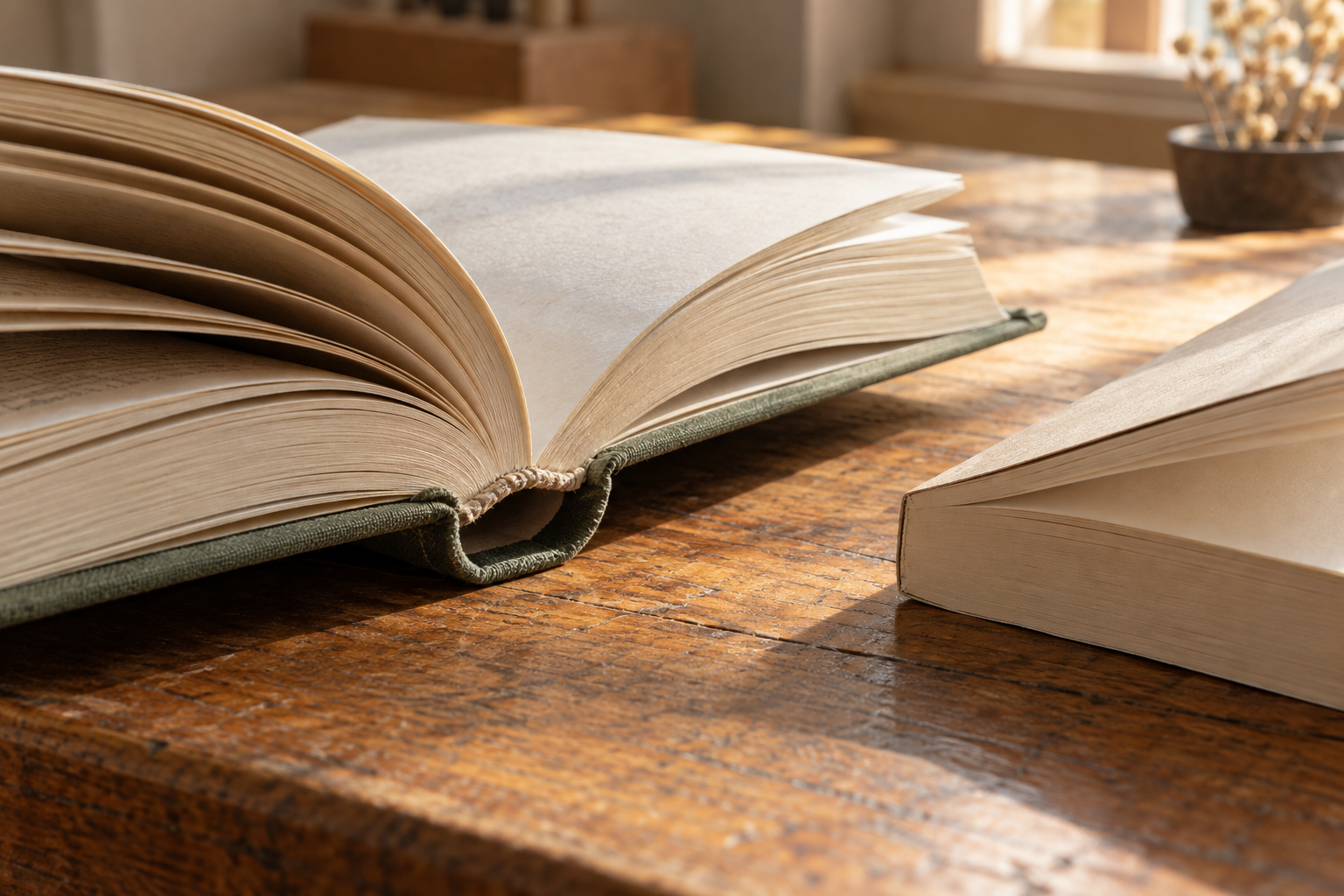
A book can resist at the first page. The cover opens, but the printed leaf rises toward it; the words nearest the spine disappear into a narrow gutter. Another book of similar size settles open with little effort. That difference is often blamed on the paper or the age of the volume. The way its pages are joined and the way its spine bends can matter just as much. A binding is a small moving system, and opening a page asks every part of it to move.
The system begins with the text block: the gathered pages before or after they are attached to a cover. Some books are made of folded groups of leaves, called sections or signatures, sewn through their folds. Others use separate leaves held at the spine edge by adhesive. The University of Illinois preservation guide describes both structures, and even separates two adhesive methods: a conventional perfect binding, with adhesive along the spine edge, and double-fan adhesive binding, in which the leaves are fanned each way so adhesive reaches between their edges. The latter can form a book that lies open flat. “Glued” alone does not tell a reader how the pages will behave.
Where the bend can go
Open a section-sewn book at the middle of a signature. The fold is already a hinge of sorts. Thread holds that fold to neighbouring sections, while the spine lining and covering decide how freely the group can move. Open at the boundary between sections and a different set of parts takes the strain. Thread, support, folded paper and lining share it; they are not merely decorative layers around the words.
Tom Conroy's study of book-spine movement names the bending of an open page across its width drape. A wider page of the same paper can drape differently from a narrow one. He also describes the spine changing shape as a book opens, from a rounded back toward a flatter or concave one. If the pages cannot drape enough and the spine is too rigid, the book may stand up on its back and try to close. If too much motion is concentrated at the gutter, folds and sewing can wear there. His paper is a mechanical analysis of Western codex structures, not a universal test result for every book on a shelf; it makes the movement visible as a balance of flexibilities.
The spine's linings help set that balance. Cloth, paper, leather, adhesive and covering material can be layered over the backs of the sections. Make those layers stiffer, and the spine may bend less; make them too weak, and it may not support repeated opening. In a Library of Congress conservation treatment of an eighteenth-century volume of Diderot's Encyclopédie, conservators describe old linings, sewing supports and replacement layers in detail. They note that a stiffly lined spine forces the leaves themselves to flex, which in that thick volume swallowed part of the image at the centre opening. The observation belongs to that historical binding and its treatment, but the mechanical trade is easy to recognise in many books: a firm back can protect one feature while asking more of the page near it.
A stitch is a structure, not a guarantee
Sewing can connect folded sections to cords or tapes and give the text block support. The Illinois guide also describes oversewing, a method used for some library bindings in which the sewing passes through the leaf margins rather than the folded centre. It can hold a large or loose-leaf book together, but the guide notes that it removes some original margin and produces a tighter gutter. Two books can therefore both be called sewn while opening quite differently.
Conservators Linda Ogden and Margaret Brown faced a more specific problem: how to resew certain Middle Eastern books without putting new adhesive on the original spine folds. Their 1998 account of an experimental structure describes a continuous support, a spine stiffener and a choice to use existing sewing holes where possible. They wanted a spine flexible enough to open but not so free that it collapsed inward. That is not a recipe to apply to any paperback. It shows how a binder chooses among strength, opening action and reversibility for a particular object. The seam is important, but so is everything attached to it.
An adhesive joint has its own range of behaviour. In the Illinois account of double-fan binding, applying adhesive to leaves fanned in both directions gives each sheet a secure spine-edge attachment and helps the bound pages lie flat. A different adhesive, paper weight, spine preparation or wear pattern can change that result. A perfect-bound paperback whose leaves only meet a layer of hot-melt adhesive at the edge can open stiffly at first and later shed a page as the joint fails. The guide describes that method as economical and useful for high use over a shorter period. The useful comparison is not a moral ranking of glue and thread; it is where each structure permits movement and how the chosen materials endure it.
The cover has a hinge too
A hard cover is not simply a thick paper wrapper. The boards must turn at their joints while the text block moves inside. In the same Library of Congress case study, the original boards had detached, making a heavy volume unsafe to handle. Conservators rebuilt the attachment with new spine covering and lining material, while preserving the book's historical appearance where possible. Their treatment account points to a distinction a reader can feel: a board may swing easily while the pages remain tight, or the pages may open while a failing joint leaves the cover unable to support them. The two motions meet at the spine but are not identical.
Nor does a handsome raised band on a spine prove what lies beneath it. The Illinois guide notes that bands once made by sewing over raised cords later became decorative features that need not reveal the actual sewing structure. A visible cover can tell part of the history, but the movement of the open book and the construction inside the gutter tell more. Even there, forcing a fragile book flat to see its stitches can cause the damage one is trying to understand.
The Library of Congress handling guide advises supporting the covers of an open book rather than pressing it to a full 180 degrees. A cradle or soft supports lower the strain by matching the opening angle the object can bear. That advice is for preserving collection material; a modern notebook meant to lie flat may need no such ceremony. The general observation is useful in either case: if a page springs back, the reader is feeling stored bending force somewhere in the paper, sewing, adhesive, spine or joints. More pressure will not change the design; it will move the strain to the weakest part.
Look at a book as it opens and its engineering becomes legible. Does the page bend across its width, or crease sharply near the inner margin? Does the spine flatten slightly, stay rigid, or collapse inward? Does the cover support the text block, or pull away from it? Those questions are more informative than a quick verdict of “sewn” or “glued.” The binding has chosen where the motion will happen. The reader feels that choice every time a page turns.
A thought worth keeping?