In a letter dated 16 October 1797, the chemist Louis-Bernard Guyton de Morveau wrote about the military use of balloons. The paper carries another message, visible when light passes through it: a beehive watermark, a smaller countermark with the initials of the French Republic, and the name B. Malherbe. The Library of Congress's transmitted-light photographs bring that quieter record out from behind the ink. The letter has a date in its text. The marks offer clues to the sheet on which the text was written.
It is tempting to turn such a mark into a neat label: a mill, a place, a year. Sometimes it supports part of that account. But a watermark is made with the paper, before someone buys, stores, transports, writes on, or prints it. To understand what it can tell us, a paper historian first asks a more physical question: which mould might have formed this sheet?
A design made in wet pulp
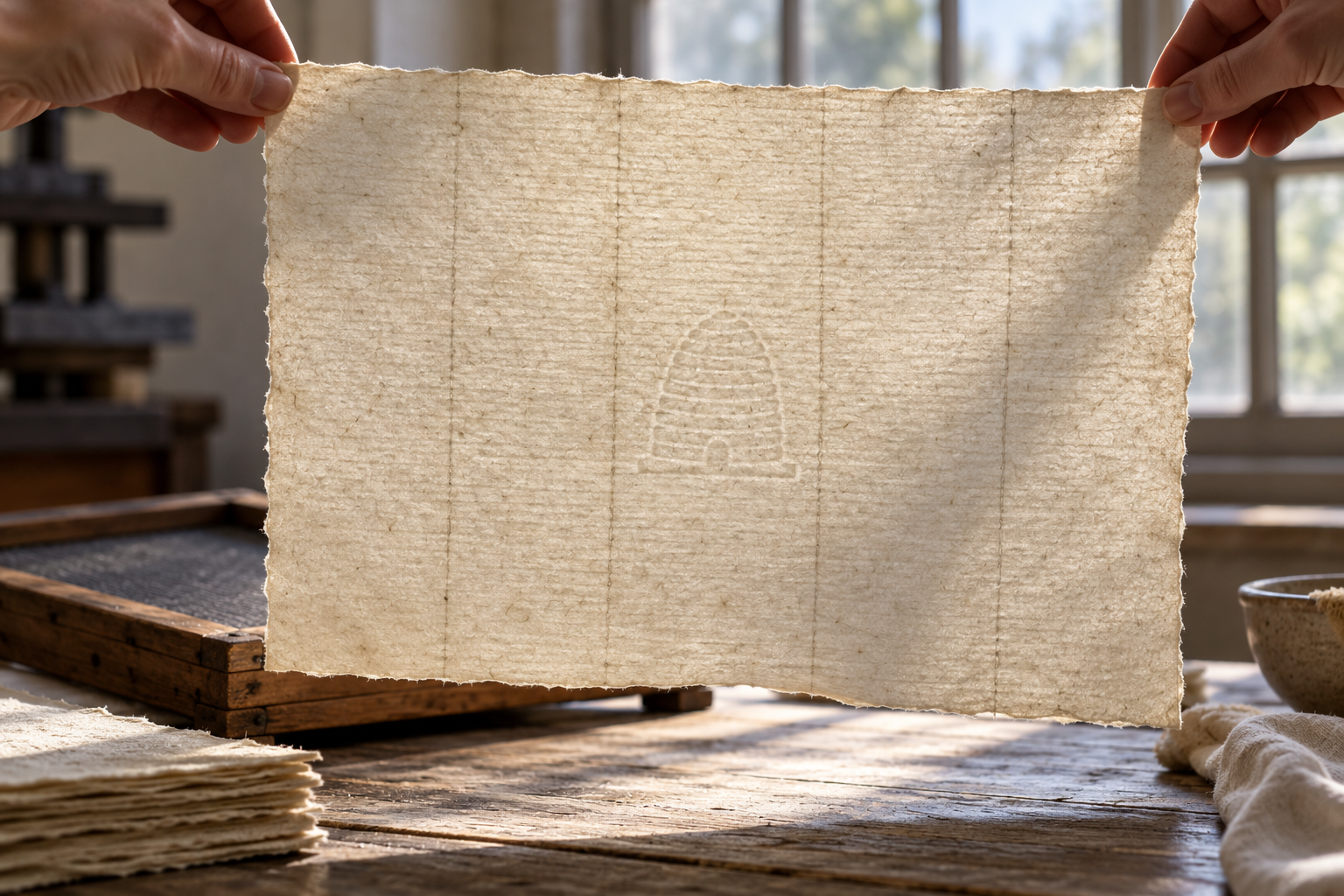
In the European hand-papermaking method described by the Library of Congress and the Austrian Academy of Sciences' paper-cataloguing guide, a worker lifted a mesh-bottomed mould through a vat of watery fibre. Water drained through the mesh; the fibres settled into a sheet. Fine, closely spaced laid lines and wider-spaced chain lines preserve something of the mould's structure in the finished paper.
A wire bent into a design and attached to that mesh changed where the fibres could settle. Over the raised wire, the paper formed thinner. Hold the dry sheet against a light and the thinner path appears brighter. The image was not ink stamped onto a completed page. It was formed within the page while the page was being made. A second, smaller design, the countermark, may appear elsewhere on a sheet. Both designs, their position, and the surrounding lines can matter more than the familiar outline of a lion, crown, or flower.
The Bates College Archive of Watermarks and Papers in Greek Manuscripts describes another complication. Papermakers commonly worked with two moulds in alternation. Their similar but individually made wire designs produced a pair of related “twin” marks. The wires could shift, bend, break, or be replaced as the moulds were used. A close resemblance between two marks might mean a paired mould, a changed mark on one mould, or only a repeated popular design. The historian must look at the small differences before declaring a match.
From a motif to a mould
An American Institute for Conservation study asks researchers to record the size and shape of the mark, its position relative to the chain lines, the spacing of those lines, any countermark, and the tiny points where the wire was tied down. Two Gothic letters that look alike at a glance can sit differently between the chain lines. The study recommends comparison at the same scale, including superimposed images or tracings, before calling marks identical. Wear may explain some changes; a different arrangement of supporting lines points toward a different mould.
That care is built into the International Association of Paper Historians' registration standard. It begins with the individual sheet and records whether the evidence comes from a complete sheet or a fragment. It also asks for the mark's position, the paper's physical features, and what is known about the object that contains it. A sketch of a motif without scale or neighbouring lines can be useful for finding candidates. It is a thin basis for assigning a particular workshop or year.
An exact match becomes valuable when another sheet from the same mould has an independently known context. The Getty Museum gives a specific example: a drawing by Jacques de Gheyn II has a horn-and-crown watermark with the initials WR. The same distinctive mark appears in paper known to have been made in Stuttgart in 1592. The comparison helps identify the paper supporting the drawing. It does not mean that the drawing itself was made in 1592; Getty dates the design to 1598–99. The gap is part of the evidence, not an error to be smoothed away.
If the comparison sheet is a dated letter rather than a securely dated production record, the inference needs another degree of caution. Its date shows that the sheet existed by the time the letter was written. A match can help establish a period in which the mould was used, but it does not supply the day the other sheet left the vat. The American Institute for Conservation paper explicitly warns that paper could travel far from its place of manufacture or be used after years in storage. The Bates archive likewise notes that a relative order of paper production need not be the order in which manuscripts were written.
The sheet may have a longer journey
The 1797 Malherbe letter is unusually generous to the reader: it has a date, a visible design, a countermark, and a maker's name. Even there, those features answer different questions. The text dates an act of writing; the marks help identify the material chosen for it. The Getty cataloguing guidance treats a watermark as a property of the paper support, normally present before the artwork was made. That distinction prevents the material's history from being mistaken for the maker's working day.
For an undated book or manuscript, the watermark can still narrow the story. Its location in a folded page can reveal something about the original sheet and the book's format; Library of Congress researchers use transmitted light to study precisely that kind of material evidence. A run of related watermarks may link sheets in different gatherings or collections. Variations caused by wear can sometimes place sheets in a relative sequence. These are useful conclusions even when no single calendar year can be defended.
Absence is less decisive. Some paper was made without a watermark; a bound volume may hide part of one, and trimming can remove a countermark. The Bates archive describes early unwatermarked papers in Greek manuscripts that can instead be studied through colour, consistency, and the pattern of their lines. The Library of Congress imaging example shows why a mark can be hard to read even when it is present: writing over the sheet interferes with the transmitted-light image. Better lighting and careful imaging improve the observation, but no image should be made to say more than the paper itself contains.
The strongest watermark account is therefore a chain of explicit steps. Describe the actual sheet; compare the design and the mould's other traces; identify the dated or located examples that support a match; then separate the sheet's manufacture from its later use. A small bright shape in a page can carry a remarkable history. Its value lies in how patiently that history is read.
A thought worth keeping?