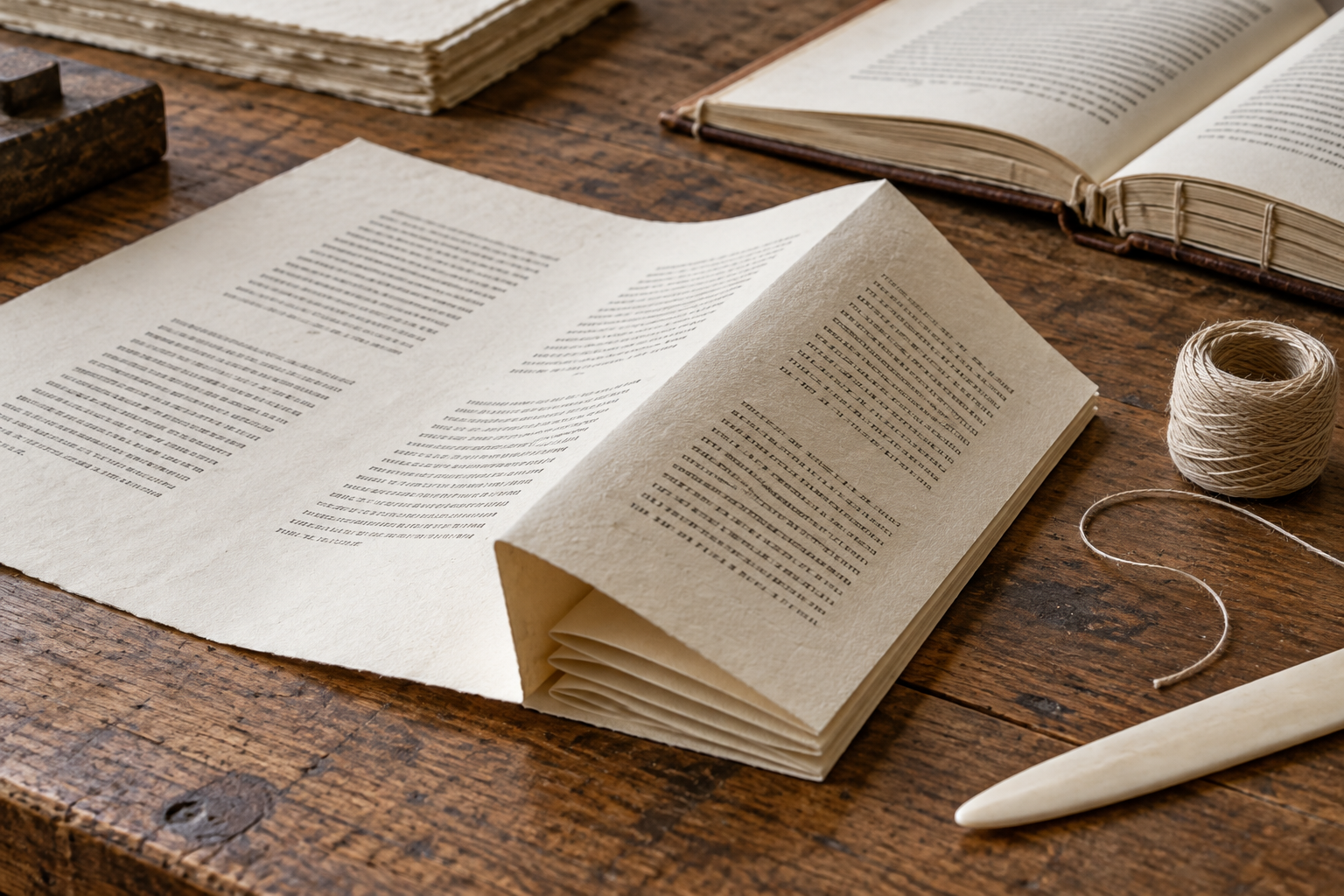
Spread a printed sheet flat before it becomes a book, and the pages may look scrambled. In one common eight-page quarto arrangement, page 1 sits on the same side of the sheet as pages 4, 5 and 8; pages 2, 3, 6 and 7 are on the reverse. The printer has not lost the plot. Once the sheet is printed, folded and cut for reading, the pages succeed one another. The Library of Congress's account of imposition shows this particular arrangement and the planning it demanded of the compositor. It is an example, rather than a universal diagram for every book called a quarto.
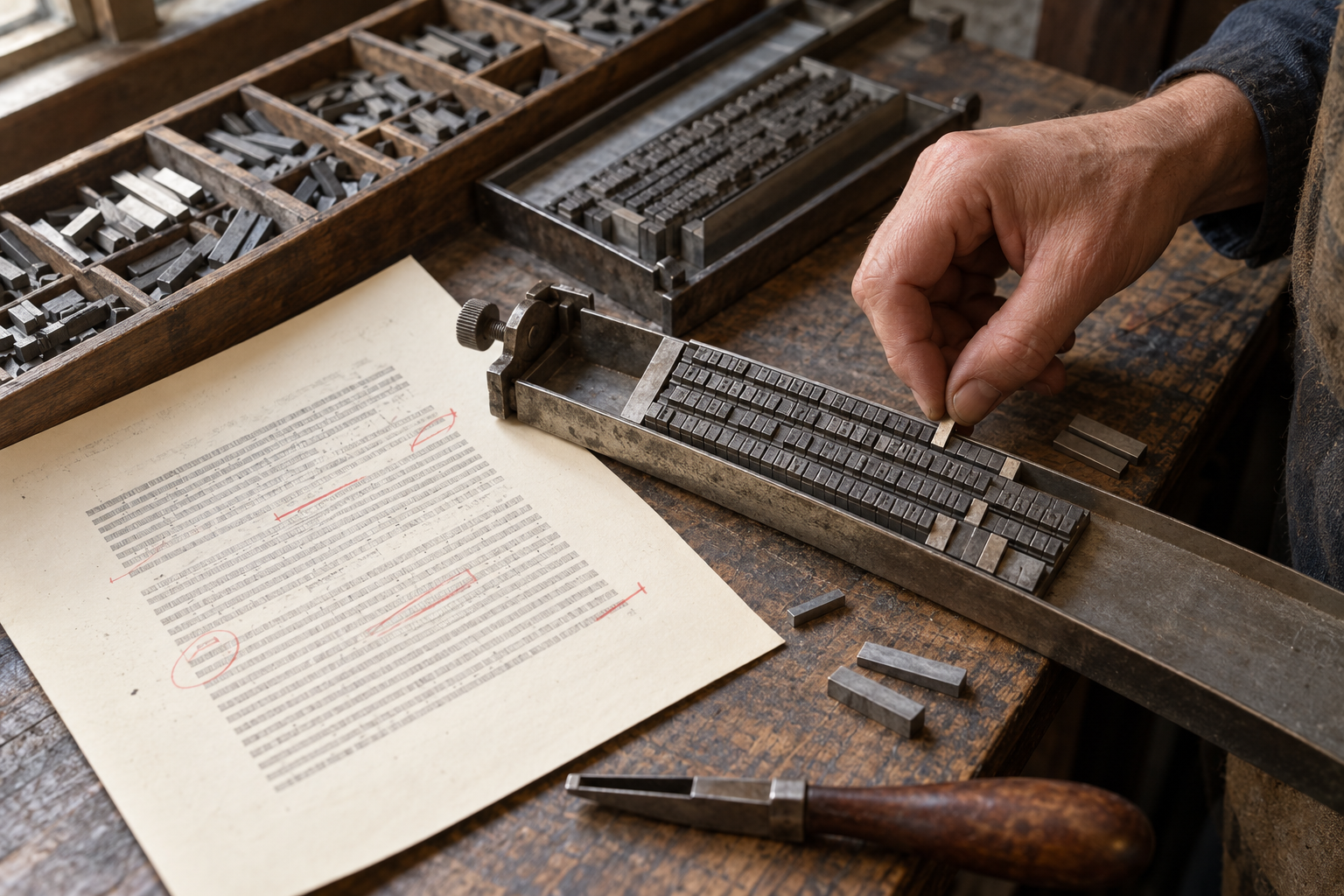
The trick matters because a book's order was built into its paper before anyone sewed a spine. A sheet is the piece of paper that went through the press. A leaf is one part of that sheet after folding, with a front and a back. A page is one side of a leaf. Fold a sheet once and it makes two leaves, four pages; fold it twice in the usual quarto fashion and it makes four leaves, eight pages. Printers could set the text into metal type on flat formes, print both sides, and let the folds put passages into reading order. For the person assembling the book, the question was not just which numbered page followed another. It was which folded pieces belonged together.
Those pieces are gatherings: groups of leaves placed one inside another for sewing. A Folger Shakespeare Library cataloger's account works through a 1513 Venetian edition of Macrobius. Its opening gathering has four leaves, many later gatherings have eight, and its final gathering has ten. A compact statement of the book's structure records those leaf counts by gathering. The numbers are not page numbers, nor a promise that every gathering was made from the same number of sheets. They describe the physical units a binder had to keep in order.
Marks for the person with the thread
Early printers often placed small letters, numbers or symbols low on some leaves. These are signature marks, guides for assembling gatherings. The marks usually appear only on the early part of a gathering because, once its first leaves are correctly placed, the rest follow their folds. Folger's guide to deciphering them explains a reference such as “A3v”: the back, or verso, of the third leaf in gathering A. It does not mean page three. This vocabulary lets a cataloger locate a misprint or missing leaf without assuming that the book even has continuous printed page numbers.
The marks are evidence, though not an infallible set of instructions. In the copy of Lucrece discussed by Folger, a leaf that belongs with gathering A carries a wrong B4 signature. If a researcher treated every printed mark as proof of structure, that error would produce a false account of the book. The fold, the sequence of text and the other marks must be read together. A physical book can contradict its own labels.
Its edges also keep part of the story. An unopened book has folds still joining adjacent leaves where a reader would normally cut them apart. An untrimmed book has edges that were not cut to a uniform block. These are different conditions. Folger's explanation of uncut, unopened and untrimmed books shows why a surviving fold can reveal how a sheet was arranged, while trimming can remove clues. A ragged edge alone does not prove a copy was never opened, and a joined edge is not automatically damage. Before cutting or repairing one, a conservator needs to know what it records.
Sometimes a fold exposes a mistake that no page number explains. Folger describes a 1627 printed sermon in which two sheets in one gathering stuck together at the press. Ink reached one side of each sheet but not the other. After folding, pairs of blank pages appeared amid the text. Seen only as a sequence of pages, the gaps might suggest that someone removed material or that the author left space. The sheet's construction points instead to an accident in printing. Its blankness is evidence of a process, not necessarily of missing words.
The same physical logic can rescue a fragment. A surviving 1598 Henry IV, Part 1 fragment consists of one four-leaf quarto gathering marked C, found in another book's binding. Even without the rest of its original volume, the mark and the linked leaves help identify where this piece once sat. The fragment is not simply eight detached pages that happen to contain Shakespeare's text. It is one unit from a particular way of making a book.
Handwritten books call for some different reasoning: their pages were not imposed in type on a printing press. Yet folded sheets and gatherings can still disclose their order. In a Library of Congress conservation account of a Persian Rumi manuscript, disbinding revealed fourteen gatherings, along with folded pairs and single leaves. Mismatched catchwords—words written at the end of a page to anticipate the next—helped show where an unknown number of leaves had gone missing. Neither the number of missing leaves nor a complete original sequence could be read off a modern page count. The conservators had to compare physical joins with the text's own handoff from one leaf to the next.
A book thus carries several orders at once. There is the sentence a reader follows, the page image the printer placed on a flat sheet, the folded leaf that preserves that placement, and the gathering the binder sewed. In a sound copy these orders cooperate so quietly that only the text draws attention. In a damaged or peculiar copy, their differences become useful. A wrong mark, an uncut fold, a blank impression or a surviving gathering can tell us how the book was made—and sometimes what happened to it after it left the press.
A thought worth keeping?